
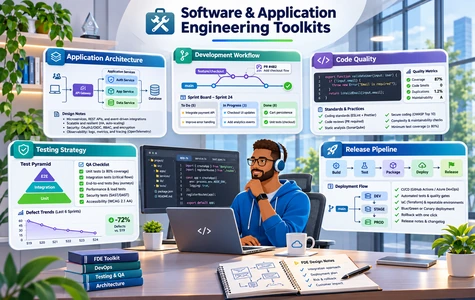
Software & Application Engineering Toolkits

Practical FDE software engineering resources for developer environments, backend APIs, accessible frontend applications, debugging, concurrency and production-grade hardening.

Software & Application Engineering Toolkits
FDE Software and Application Engineering Toolkits for APIs, frontend, debugging and production hardening

Forward Deployed Engineers must turn enterprise requirements into dependable software that works within real customer environments. The Software & Application Engineering Toolkits bring together practical engineering reference materials, implementation checklists, hands-on coding labs and sample files to help teams structure this work.

Organized into 6 practical parts and 35 indexed files, the toolkit covers developer workspaces and dependencies; Python and TypeScript foundations; backend service and API implementation; accessible frontend interactions; debugging and refactoring; concurrency and background processing; and production-grade application design, profiling and hardening.

The collection combines DOC guides, XLS working checklists, Python and TypeScript exercises, JSON/JSONL/CSV data, a Draw.io wireframe and ZIP lab projects. FDE engineers and engineering managers can adapt these materials to their own technology stack, architectural requirements and customer delivery controls.

Benefits of This Toolkit
  • Prepare repeatable development environments with workspace setup guidance, dependency records and practical Python/TypeScript exercises.
  • Implement more consistent backend APIs using service starter code, request/response schemas, validation exercises and contract review checklists.
  • Improve frontend usability and accessibility through interface specifications, acceptance rubrics, interaction wireframes and state-handling exercises.
  • Diagnose defects and reduce maintainability risk with bug reproduction procedures, code complexity reviews, refactoring comparisons and debugging labs.
  • Address concurrency and production readiness through job queue labs, race-condition simulations, profiling workbooks, hardening guidance and code quality gates.
Toolkit Documents

Below is the complete file inventory from Index 07: 35 files across 6 parts, including software engineering guides, spreadsheets, source-code labs, structured test data, a diagram and ZIP project bundles.

TypeFiles List
Part 1. Developer Environments, Dependencies & Programming Foundations
Word documentDeveloper_Workspace_Setup_Guide.doc
Excel workbookDeveloper_Environment_Readiness.xls
Programming_Foundations_Python_Lab.py
Programming_Foundations_TypeScript_Lab.ts
Developer_Dependency_Manifest.txt
Part 2. Backend Services, APIs & Application Programming
Word documentBackend_API_Implementation_Guide.doc
Excel workbookBackend_Contract_Implementation_Checklist.xls
Backend_Service_Starter.py
Backend_Validation_and_Error_Handling_Exercise.py
Backend_Request_Response_Schemas.json
Backend_Lab_Test_Fixtures.json
Part 3. Frontend, User Experience & Accessible Application Engineering
Word documentUser_Interface_Interaction_Specification.doc
Excel workbookAccessible_Interface_Implementation_Checklist.xls
Excel workbookFrontend_Acceptance_Rubric.xls
Frontend_Interaction_Wireframe.drawio
Frontend_State_Handling_Exercise.ts
Frontend_Usability_Test_Data.json
Frontend_Application_Starter.zip
Part 4. Debugging, Refactoring & Code Maintainability
Word documentBug_Reproduction_Procedure.doc
Excel workbookCode_Complexity_Review_Workbook.xls
Excel workbookRefactoring_Before_After_Comparison.xls
Excel workbookMaintainability_Review_Checklist.xls
Defective_Application_Debugging_Lab.zip
Part 5. Concurrency, Background Processing & Application State Consistency
Excel workbookConcurrency_Review_Rubric.xls
Concurrency_And_Race_Condition_Lab.py
Asynchronous_Job_Queue_Implementation_Lab.py
Distributed_State_Consistency_Simulation.py
Concurrency_Trace_Sample_Data.jsonl
Part 6. Production-Grade Application Design, Profiling & Hardening
Word documentProduction_App_Hardening_Playbook.doc
Word documentRobustness_Case_Challenge.doc
Excel workbookApplication_Performance_Profiler.xls
Excel workbookApplication_Engineering_Design_Review.xls
Excel workbookProduction_Code_Quality_Gate.xls
Configuration_Error_Handling_Exercise.py
Application_Profiling_Dataset.csv

Price: $47.00

PayPal Cards

Secure payment via PayPal. Instant digital delivery after successful payment.

Download index filePayment guide

Date File Updated10/04/2025
File Formatdoc, xls, py, ts, json, jsonl, txt, drawio, zip, csv
No. of files35 Files, 6 Folders
File download size3.02 MB (.rar)
LanguageEnglish English

This document has been certified by a professional

100% customizable. You can edit our templates as needed.

Instant download after completing your order.

We recommend downloading this file onto your computer.

Your payment information is processed securely.

After payment, if you require an invoice, please email us.

Support contact: supports@it-toolkits.org

FORWARD DEPLOYED ENGINEERING TOOLKIT

Build, validate and harden software for real-world FDE delivery

Practical engineering files for developer setup, Python and TypeScript, backend API implementation, accessible frontend development, debugging, concurrency, application profiling and production readiness.

FAQs

1. Who should use the Software & Application Engineering Toolkits?

These resources are aimed at Forward Deployed Engineers, software engineers, technical leads, full-stack developers, engineering enablement teams and FDE managers working on enterprise applications and customer integrations.

2. What is included in the software engineering toolkit?

Index 07 lists materials for developer environments, programming foundations, backend APIs, frontend interaction design, debugging and refactoring, concurrent processing, and production-grade application hardening.

3. How many files and parts are in the toolkit?

The supplied index contains 35 files in 6 parts: 6 DOC, 11 XLS, 7 PY, 2 TS, 3 JSON, 1 JSONL, 1 TXT, 1 DRAWIO, 2 ZIP and 1 CSV file.

4. Can I review the document inventory before buying?

Yes. The Toolkit Documents table above reproduces the file names and part structure from Index 07. The page also retains the original document-index download control and Payment Guide link.

5. How does Part 1 help developers prepare their workspace?

Part 1 lists a Developer Workspace Setup Guide, Developer Environment Readiness workbook, Python and TypeScript foundations labs, and a dependency manifest to support repeatable local preparation.

6. Are both Python and TypeScript covered?

Yes. The index includes Python (.py) and TypeScript (.ts) exercises, with additional JSON and CSV sample data. These are development and practice materials rather than a claim of compatibility with every runtime.

7. What backend and API resources are available?

Part 2 includes a Backend API Implementation Guide, contract implementation checklist, Python backend service starter, validation/error-handling exercise, request/response schemas and lab fixtures.

8. Does the toolkit address backend request validation and error handling?

Yes. The index specifically includes Backend_Validation_and_Error_Handling_Exercise.py and Backend_Request_Response_Schemas.json to support work on validation and structured API contracts.

9. What is included for frontend and user experience engineering?

Part 3 contains a user interface interaction specification, accessibility checklist, frontend acceptance rubric, Draw.io wireframe, TypeScript state-handling exercise, usability test data and a starter application ZIP.

10. Are accessible interface practices addressed?

Yes. The Accessible_Interface_Implementation_Checklist.xls and Frontend_Acceptance_Rubric.xls provide named review artifacts for accessibility and user-interface acceptance.

11. Does the toolkit provide debugging and refactoring materials?

Part 4 includes a bug reproduction procedure, code complexity workbook, before/after refactoring comparison, maintainability checklist and a defective-application debugging lab ZIP.

12. Are concurrency and race conditions covered?

Part 5 lists a concurrency review rubric, race-condition Python lab and distributed state-consistency simulation, plus structured trace sample data in JSONL format.

13. Does it contain background processing and job queue examples?

Yes. Asynchronous_Job_Queue_Implementation_Lab.py is one of the indexed Part 5 files for practicing background-job implementation concepts.

14. How does the toolkit support production-grade hardening?

Part 6 includes a production application hardening playbook, robustness challenge, configuration/error-handling exercise, profiling workbook, engineering design review and production code quality gate.

15. Can I assess application performance and code quality?

Yes. The index lists Application_Performance_Profiler.xls, Application_Engineering_Design_Review.xls, Production_Code_Quality_Gate.xls and an application profiling CSV dataset.

16. Can the source code, diagrams and templates be adapted?

The package lists editable document formats and source-code exercises. Customize the examples and review artifacts for your actual stack, development standards, accessibility obligations, security controls and deployment environment.

17. How much does the toolkit cost and how do I pay?

The displayed price is $47.00 USD. The two purchase controls use the existing PayPal checkout code from the provided HTML template; consult the website Payment Guide for the payment process.

18. Where can I get help opening the engineering files?

For assistance with the order or file formats, contact supports@it-toolkits.org. The indexed ZIP, code, spreadsheet and diagram assets require appropriate compatible applications or development tools.