
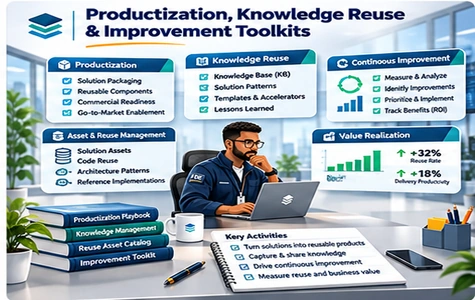
Productization, Knowledge Reuse & Improvement Toolkits

Practical FDE productization and continuous improvement resources for field feedback, reusable solution patterns, component packaging, knowledge publishing and reuse impact.

Productization, Knowledge Reuse & Improvement Toolkits
Productization, Knowledge Reuse & Improvement Toolkits: field feedback, reusable engineering patterns, knowledge management and continuous improvement

Forward Deployed Engineers continuously encounter customer needs, deployment constraints and proven technical solutions. The Productization, Knowledge Reuse & Improvement Toolkits help FDE, product and engineering teams convert those field insights into actionable product opportunities, maintainable reusable assets and measured improvements rather than isolated engagement outcomes.

Organized into 6 practical parts and 40 indexed files, the toolkit covers collection and validation of field feedback, opportunity clustering and roadmap handoffs, reusable solution patterns and reference architectures, component versioning and compatibility, technical knowledge publishing and intellectual-property safeguards, and continuous improvement backed by reuse and outcome measurement.

The collection includes DOC guides and exercises, XLS registers and evaluation workbooks, an editable Draw.io architecture example, Python compatibility testing, YAML and JSON examples, a reference ZIP package and CSV case data. Adapt these working materials to your engineering standards, customer confidentiality agreements, software licenses and product release processes.

Benefits of This Toolkit
  • Translate field feedback into product direction using evidence validation, observation catalogs, gap clustering, prioritization and roadmap handoff templates.
  • Identify solutions worth reusing through pattern specifications, architectural examples, selection criteria and variation analysis.
  • Package maintainable engineering components with versioning guidance, readiness criteria, interface contracts and compatibility tests.
  • Publish knowledge responsibly using authoring standards, peer review, customer-data reuse exclusions, IP controls and open-source attribution checks.
  • Measure the value of reuse and improvement with adoption dashboards, improvement backlogs, attribution workbooks and before-and-after examples.
Toolkit Documents

Below is the complete document inventory from the supplied toolkit index: 40 files organized across 6 parts. The index includes DOC, XLS, Draw.io, Python, YAML, JSON, ZIP and CSV working materials.

TypeFiles List
Part 1. Customer Field Feedback, Signals & Evidence Quality
Product_Field_Feedback_Playbook.doc
Field_Observation_Interview_Tagging_Cards.doc
Field_Evidence_Validation_Procedure.doc
Field_Observation_Feedback_Catalog.xls
Feedback_Synthesis_Review_Checklist.xls
Part 2. Product Opportunities, Prioritization & Roadmap Handoffs
Field_To_Product_Signal_Exercise.doc
Field_Product_Roadmap_Handoff_Brief.doc
Customer_Request_Opportunity_Casebook.doc
Product_Gap_Clustering_Workbook.xls
Opportunity_Feasibility_Value_Matrix.xls
Feature_Opportunity_Priority_Workbook.xls
Part 3. Reusable Solution Patterns & Reference Architecture Assets
Reusable_Solution_Pattern_Specification.doc
Reusable_Solution_Extraction_Exercise.doc
Reusable_Pattern_Selection_Criteria.xls
Solution_Pattern_Variation_Analysis.xls
Pattern_Quality_Review.xls
Pattern_Architecture_Example.drawio
Part 4. Reusable Engineering Components, Versioning & Packaging
Reusable_Component_Versioning_Guide.doc
Engineering_Component_Reuse_Case.doc
Reusable_Component_Installation_and_Consumer_Guide.doc
Reusable_Component_Productization_Checklist.xls
Component_Release_Readiness_Rubric.xls
Component_Compatibility_Test_Suite.py
Component_Interface_Design_Contract.yaml
Component_Consumer_Compatibility_Test_Fixtures.json
Reusable_Component_Reference_Package.zip
Part 5. Technical Knowledge Publishing, Intellectual Property & Enablement
Engineering_Knowledge_Publication_Procedure.doc
Knowledge_Article_Authoring_Template.doc
Engineering_Knowledge_Style_Guide.doc
Asset_IP_Confidentiality_Review_Checklist.xls
Customer_Data_Reuse_Exclusion_Test.xls
Knowledge_Article_Peer_Review.xls
Open_Source_License_and_Third_Party_Attribution_Release_Checklist.xls
Part 6. Engineering Continuous Improvement & Reuse Impact Measurement
Continuous_Improvement_Experiment_Playbook.doc
Lessons_To_Product_Improvement_Case.doc
Engineering_Improvement_Backlog.xls
Reusable_Asset_Adoption_Dashboard.xls
Reuse_Outcome_Attribution_Workbook.xls
Engineering_Reuse_Impact_Review.xls
Improvement_Before_After_Case_Data.csv

Price: $47.00

PayPal Cards

Secure payment via PayPal. Instant digital delivery after successful payment.

Download index filePayment guide

Date File Updated10/04/2025
File Formatdoc, xls, drawio, py, yaml, json, zip, csv
No. of files40 Files, 6 Folders
File download size3.02 MB (.rar)
LanguageEnglish English

This document has been certified by a professional

100% customizable. You can edit our templates as needed.

Instant download after completing your order.

We recommend downloading this file onto your computer.

Your payment information is processed securely.

After payment, if you require an invoice, please email us.

Support contact: supports@it-toolkits.org

FORWARD DEPLOYED ENGINEERING TOOLKIT

Turn field knowledge into reusable engineering value

Capture trusted customer feedback, transfer product opportunities, standardize reusable patterns and components, publish technical knowledge safely and measure engineering improvement.

FAQs

1. Who is the Productization, Knowledge Reuse & Improvement Toolkit designed for?

This toolkit is designed for Forward Deployed Engineers, product managers, product engineering leaders, solution architects, technical enablement teams and engineering practice leads who turn field experience into repeatable product and engineering value.

2. What exactly is included in this FDE toolkit?

Index 21 identifies 40 working files across 6 parts: customer field feedback; product opportunities and roadmap handoffs; reusable solution patterns; component packaging and versioning; technical knowledge publication and IP controls; and engineering continuous improvement and reuse measurement.

3. Which file formats and how many files are included?

The supplied index lists 16 DOC, 18 XLS, 1 Draw.io, 1 Python, 1 YAML, 1 JSON, 1 ZIP and 1 CSV file. The complete filenames and their order are displayed in the Toolkit Documents table.

4. Can I review the document index before purchasing?

Yes. This page reproduces the full indexed document inventory. The existing index-download control and Payment Guide remain in their original positions; you may contact supports@it-toolkits.org to confirm the correct downloadable index.

5. How does the toolkit support evidence-based field feedback?

Part 1 includes Product_Field_Feedback_Playbook.doc, observation-tagging cards, a field evidence validation procedure, a feedback catalog and a synthesis review checklist. Together, they help teams organize and assess what has actually been observed during engagements.

6. Can FDE teams convert customer requests into product roadmap inputs?

Part 2 provides a field-to-product signal exercise, roadmap handoff brief, customer request casebook and spreadsheets for product gap clustering, feasibility/value evaluation and feature opportunity prioritization.

7. How are customer signals distinguished from product opportunities?

The feedback tools in Part 1 support observation and evidence quality. The prioritization tools in Part 2 help engineering and product teams compare potential opportunities before recommending a roadmap handoff; final decisions remain with the organization’s product governance process.

8. Does the toolkit include reusable solution patterns and reference architectures?

Yes. Part 3 lists a reusable solution pattern specification, extraction exercise, pattern selection criteria, variation analysis, quality review and Pattern_Architecture_Example.drawio.

9. What is the purpose of the reusable architecture example?

The Draw.io file offers a working architecture example to adapt when documenting a reusable solution pattern. Teams should review its design against their own target environments, interface constraints, security expectations and implementation standards.

10. Does it cover reusable components, packaging and versioning?

Part 4 includes a Reusable_Component_Versioning_Guide.doc, installation and consumer guide, productization checklist, release readiness rubric, interface design contract and a reusable reference ZIP package.

11. Are software compatibility tests and sample technical files provided?

Part 4 lists Component_Compatibility_Test_Suite.py, Component_Interface_Design_Contract.yaml, Component_Consumer_Compatibility_Test_Fixtures.json and a reference package. Review and run technical examples only in an authorized test environment.

12. How does this toolkit support engineering knowledge publication?

Part 5 includes an engineering knowledge publication procedure, article authoring template, style guide and peer-review workbook to structure the creation, review and maintenance of practical technical knowledge.

13. Does it address confidentiality and intellectual property when reusing customer work?

Yes. Part 5 lists Asset_IP_Confidentiality_Review_Checklist.xls and Customer_Data_Reuse_Exclusion_Test.xls. These are review aids; teams must still obtain required permissions and follow customer contracts and applicable law.

14. Are open-source licensing and third-party attribution included?

Part 5 includes an Open_Source_License_and_Third_Party_Attribution_Release_Checklist.xls to support review of licensing and attribution questions before publishing or distributing reusable assets.

15. How can engineering teams measure adoption and value from reused assets?

Part 6 provides a Reusable_Asset_Adoption_Dashboard.xls, reuse outcome attribution workbook and engineering reuse impact review to organize evidence of usage, outcomes and improvement opportunities.

16. Does the toolkit include continuous improvement experiments and example data?

Yes. Part 6 includes a continuous improvement experiment playbook, lessons-to-product case, improvement backlog and Improvement_Before_After_Case_Data.csv for practical review and comparison exercises.

17. What is the price and how does PayPal checkout work?

The advertised price is $47.00 USD. The two PayPal checkout forms are preserved from the source HTML and require a product-specific hosted button update before live selling. Please consult the Payment Guide or contact supports@it-toolkits.org.

18. Can the toolkit be customized and where can I obtain assistance?

The DOC, XLS, Draw.io and supporting technical files can be adapted to organizational workflows and engineering environments. For file-format, index, access or general toolkit questions, contact supports@it-toolkits.org.