
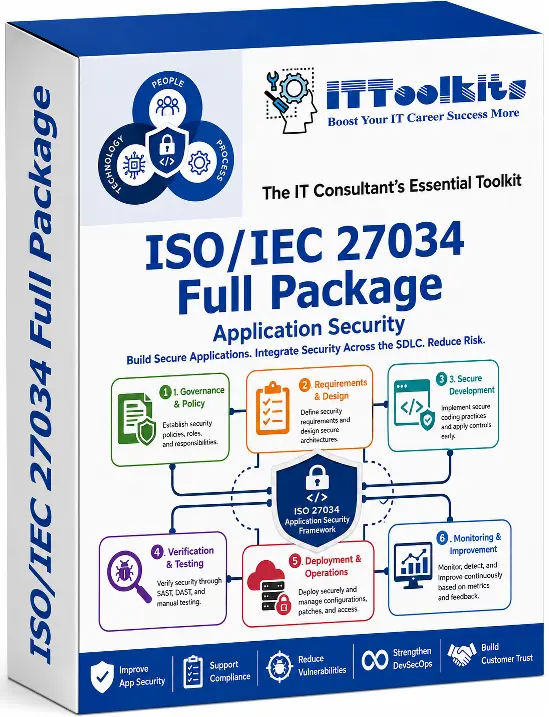
Applications increasingly support critical business processes and handle sensitive information, making application security a core part of enterprise risk management. The ISO/IEC 27034:2018 Application Security Toolkits provide a structured, standards aligned foundation for managing application security risks throughout the application lifecycle.
The toolkit brings together policies, procedures, checklists, templates, and secure SDLC resources that help organisations embed security into development, testing, deployment, maintenance, governance, and approval activities. This gives security, IT, development, compliance, and project teams a consistent way to document and operate application security practices.
By using the toolkit, organisations can strengthen application security governance, reduce implementation gaps, standardise documentation, and improve audit and compliance readiness while building a repeatable approach to protecting business applications and the data they process.
Below is a list of documents you will find in the toolkit. Click on index file button to see which templates are included.
| Type | Files List |
|---|---|
 Part 1. Engagement Initiation & Program Mobilization Part 1. Engagement Initiation & Program Mobilization📌 Objective: To provide practical templates for initiating the ISO/IEC 27034 implementation engagement, mobilizing project governance, defining scope, assigning responsibilities, and managing project communication, risks, deliverables, and closure. | |
 | ISO IEC 27034 Implementation Project Charter.docx |
| Application Security Implementation Roadmap.docx |
| Consulting Engagement Scope Statement.docx |
| Executive Sponsorship Brief.docx |
| Project Governance Structure.docx |
| Project Communication Plan.docx |
| Project Kick off Meeting Agenda.docx |
| Project Meeting Minutes.docx |
| Project Deliverables Acceptance Form.docx |
| Change Request Form.docx |
| Project Closure Report.docx |
 | Stakeholder Register.xlsx |
| Implementation Roles and Responsibilities Matrix.xlsx |
| RACI Matrix.xlsx |
| Project Action Log.xlsx |
| Project Risk and Issue Register.xlsx |
| Project Assumption and Constraint Log.xlsx |
| Project Status Report.xlsx |
 | Project Kick off Presentation.pptx |
| Steering Committee Report.pptx |
| Part 2. Organizational Context & Application Security Governance 📌 Objective: To define organizational context, application security governance structures, policies, objectives, accountability mechanisms, decision rights, and management review practices required to support ISO/IEC 27034 implementation. | |
| Organizational Context Analysis.docx |
| Business Unit Application Security Profile.docx |
| Application Security Governance Framework.docx |
| Application Security Policy.docx |
| Application Security Management System Scope.docx |
| Application Security Objectives.docx |
| Application Security Principles.docx |
| Application Security Governance Committee Charter.docx |
| Enterprise Application Security Operating Model.docx |
| Application Security Governance Meeting Agenda.docx |
| Application Security Governance Meeting Minutes.docx |
| Application Security Management Review Report.docx |
| Application Security Governance Improvement Plan.docx |
| Application Security Decision Rights Matrix.xlsx |
| Application Security Accountability Matrix.xlsx |
| Application Security Authority and Escalation Matrix.xlsx |
| Application Security Governance KPI Dashboard.xlsx |
| Application Security Governance Executive Briefing.pptx |
| Part 3. ISO IEC 27034 Gap Assessment & Baseline Review 📌 Objective: To support a structured baseline review and gap assessment against ISO/IEC 27034, enabling organizations to identify current state weaknesses, prioritize remediation actions, and establish an improvement roadmap. | |
| ISO IEC 27034 Gap Assessment Plan.docx |
| ISO IEC 27034 Gap Assessment Checklist.docx |
| Current State Assessment Questionnaire.docx |
| Application Security Maturity Assessment.docx |
| Application Security Capability Assessment.docx |
| Existing Controls Review.docx |
| Secure SDLC Assessment.docx |
| Application Security Documentation Review Checklist.docx |
| Interview Guide for Business Owners.docx |
| Interview Guide for IT and Development Teams.docx |
| Interview Guide for Security Teams.docx |
| Gap Assessment Report.docx |
| Remediation Roadmap.docx |
| ISO IEC 27034 Clause Mapping Assessment.xlsx |
| Application Portfolio Security Baseline.xlsx |
| Gap Assessment Evidence Register.xlsx |
| Gap Assessment Findings Log.xlsx |
| Gap Prioritization Matrix.xlsx |
| Gap Assessment Executive Presentation.pptx |
| Part 4. Application Inventory & Classification 📌 Objective: To establish a complete inventory and classification framework for business applications, including ownership, criticality, data classification, dependencies, lifecycle status, and risk based prioritization. | |
| Application Registration Form.docx |
| Application Business Criticality Assessment.docx |
| Application Data Classification.docx |
| Application Risk Classification.docx |
| Application Architecture Profile.docx |
| Application Technology Stack Profile.docx |
| Enterprise Application Inventory.xlsx |
| Application Ownership Register.xlsx |
| Application Dependency Mapping.xlsx |
| Third party Application Register.xlsx |
| Cloud Application Register.xlsx |
| Legacy Application Register.xlsx |
| Internet facing Application Register.xlsx |
| Crown Jewel Application Identification.xlsx |
| Application Lifecycle Status Register.xlsx |
| Application Decommissioning Candidate Register.xlsx |
| Application Portfolio Classification Summary.pptx |
| Part 5. Organizational Normative Framework 📌 Objective: To define the organizational normative framework for application security, including policies, standards, procedures, control libraries, requirements catalogues, and review mechanisms aligned with business and regulatory needs. | |
| Organizational Normative Framework Definition.docx |
| Secure Architecture Standard.docx |
| Secure Coding Standard.docx |
| Secure Configuration Standard.docx |
| Secure API Development Standard.docx |
| Secure Mobile Application Standard.docx |
| Secure Cloud Application Standard.docx |
| Secure DevOps Standard.docx |
| Cryptography Usage Standard.docx |
| Authentication and Authorization Standard.docx |
| Logging and Monitoring Standard.docx |
| Data Protection Standard for Applications.docx |
| Privacy by Design Requirement.docx |
| Normative Framework Approval Form.docx |
| Application Security Policy Set Register.xlsx |
| Application Security Standards Register.xlsx |
| Application Security Procedures Register.xlsx |
| Application Security Guidelines Register.xlsx |
| Application Security Control Library.xlsx |
| Application Security Requirement Catalogue.xlsx |
| Regulatory and Legal Requirement Mapping.xlsx |
| Normative Framework Review Log.xlsx |
| Organizational Normative Framework Overview.pptx |
| Part 6. Application Security Risk Management 📌 Objective: To provide a structured approach for identifying, assessing, treating, accepting, escalating, and monitoring application security risks across the application lifecycle. | |
| Application Security Risk Management Procedure.docx |
| Application Security Risk Assessment Methodology.docx |
| Application Risk Assessment Plan.docx |
| Application Risk Assessment Questionnaire.docx |
| Threat Identification.docx |
| Vulnerability Identification.docx |
| Business Impact Assessment.docx |
| Risk Treatment Plan.docx |
| Risk Acceptance Form.docx |
| Risk Exception Request.docx |
| Residual Risk Review.docx |
| Risk Escalation Form.docx |
| Risk Review Meeting Minutes.docx |
| Risk Scenario Register.xlsx |
| Application Risk Register.xlsx |
| Application Risk Rating Matrix.xlsx |
| Risk Ownership Register.xlsx |
| Application Security Risk Dashboard.xlsx |
| Application Security Risk Executive Report.pptx |
| Part 7. Application Security Controls Design 📌 Objective: To support the design, selection, specification, assignment, testing, and continual improvement of application security controls based on risk, applicability, and control effectiveness. | |
| Application Security Control Selection Procedure.docx |
| Application Security Control Objective.docx |
| Application Security Control Specification.docx |
| Control Implementation Plan.docx |
| Preventive Control Design.docx |
| Detective Control Design.docx |
| Corrective Control Design.docx |
| Manual Control Design.docx |
| Automated Control Design.docx |
| Control Testing Procedure.docx |
| Control Effectiveness Assessment.docx |
| Control Improvement Plan.docx |
| Application Security Control Catalogue.xlsx |
| Control Applicability Matrix.xlsx |
| Security Control Traceability Matrix.xlsx |
| Control Owner Assignment Register.xlsx |
| Control Exception Register.xlsx |
| Application Security Controls Design Summary.pptx |
| Part 8. Application Normative Framework 📌 Objective: To define application specific normative frameworks, security requirements, acceptance criteria, baseline configurations, control evidence, and approval mechanisms for individual applications. | |
| Application Normative Framework.docx |
| Application specific Security Requirements.docx |
| Application Security Target Profile.docx |
| Application Security Acceptance Criteria.docx |
| Application Security Baseline Configuration.docx |
| Application Security Architecture Decision Record.docx |
| Application specific Risk Treatment Plan.docx |
| Application Security Control Implementation Evidence.docx |
| Application Security Control Verification Checklist.docx |
| Application Normative Framework Approval Form.docx |
| Application specific Control Set.xlsx |
| Application Security Requirement Traceability Matrix.xlsx |
| Application Normative Framework Review Log.xlsx |
| Application Normative Framework Summary.pptx |
| Part 9. Secure SDLC Integration 📌 Objective: To embed application security into each phase of the secure software development lifecycle, including requirements, design, coding, testing, CI/CD controls, defect management, and release readiness. | |
| Secure SDLC Policy.docx |
| Secure SDLC Procedure.docx |
| Secure SDLC Phase Gate Checklist.docx |
| Security Requirements Elicitation.docx |
| Security Requirements Specification.docx |
| Security User Story.docx |
| Security Acceptance Criteria.docx |
| Secure Design Review Checklist.docx |
| Threat Modeling Procedure.docx |
| Threat Modeling Worksheet.docx |
| Attack Surface Analysis.docx |
| Secure Coding Checklist.docx |
| Code Review Checklist.docx |
| Static Application Security Testing Procedure.docx |
| Dynamic Application Security Testing Procedure.docx |
| Software Composition Analysis Procedure.docx |
| Infrastructure as Code Security Review.docx |
| Container Security Review Checklist.docx |
| CI/CD Security Control Checklist.docx |
| Security Defect Management Procedure.docx |
| Security Gate Approval Form.docx |
| Release Security Readiness Checklist.docx |
| Security Defect Register.xlsx |
| Secure SDLC Integration Overview.pptx |
| Part 10. Architecture & Design Security 📌 Objective: To provide structured templates for reviewing application architecture and design security, including data flows, trust boundaries, authentication, authorization, cryptography, cloud, microservices, and zero trust considerations. | |
| Application Security Architecture Review Procedure.docx |
| Application Architecture Review Checklist.docx |
| Security Architecture Diagram.docx |
| Data Flow Diagram.docx |
| Trust Boundary Diagram.docx |
| Authentication Design Review.docx |
| Authorization Design Review.docx |
| Session Management Design Review.docx |
| API Security Design Review.docx |
| Cryptographic Design Review.docx |
| Logging and Monitoring Design Review.docx |
| Data Protection Design Review.docx |
| Secure Integration Design Review.docx |
| Cloud Security Architecture Review.docx |
| Microservices Security Architecture Review.docx |
| Zero Trust Application Architecture Review.docx |
| Architecture Risk Decision Record.docx |
| Architecture Exception Register.xlsx |
| Application Security Architecture Review Presentation.pptx |
| Part 11. Supplier, Third party & Outsourced Development Management 📌 Objective: To manage application security risks related to suppliers, third party software, outsourced development, open source components, contractual requirements, and supplier evidence management. | |
| Supplier Application Security Requirement.docx |
| Third party Software Security Assessment.docx |
| Supplier Security Due Diligence Questionnaire.docx |
| Outsourced Development Security Agreement.docx |
| Secure Development Contract Clause.docx |
| Supplier Security Review Checklist.docx |
| Supplier Vulnerability Disclosure Requirement.docx |
| Supplier Corrective Action Plan.docx |
| Supplier Security Responsibility Matrix.xlsx |
| Third party Component Inventory.xlsx |
| Open source Component Register.xlsx |
| Software Bill of Materials.xlsx |
| Third party Risk Assessment.xlsx |
| Supplier Security Evidence Register.xlsx |
| Supplier Non conformance Register.xlsx |
| Supplier Application Security Management Summary.pptx |
| Part 12. Application Security Testing & Verification 📌 Objective: To support planning, execution, evidence collection, reporting, and closure of application security testing activities, including SAST, DAST, IAST, SCA, penetration testing, API, mobile, cloud, and configuration testing. | |
| Application Security Testing Strategy.docx |
| Application Security Test Plan.docx |
| Security Test Case.docx |
| SAST Execution Report.docx |
| DAST Execution Report.docx |
| IAST Execution Report.docx |
| SCA Execution Report.docx |
| Penetration Testing Scope.docx |
| Penetration Testing Rules of Engagement.docx |
| Penetration Testing Report.docx |
| API Security Testing Checklist.docx |
| Mobile Application Security Testing Checklist.docx |
| Cloud Application Security Testing Checklist.docx |
| Secure Configuration Testing Checklist.docx |
| Authentication Testing Checklist.docx |
| Authorization Testing Checklist.docx |
| Input Validation Testing Checklist.docx |
| Business Logic Testing Checklist.docx |
| Security Test Closure Report.docx |
| Security Test Evidence Register.xlsx |
| Security Test Defect Log.xlsx |
| Application Security Testing Results Presentation.pptx |
| Part 13. Vulnerability & Defect Management 📌 Objective: To standardize vulnerability and security defect management processes, including intake, triage, severity rating, remediation, exception handling, retesting, closure, escalation, and performance monitoring. | |
| Application Vulnerability Management Procedure.docx |
| Vulnerability Intake Form.docx |
| Vulnerability Triage Checklist.docx |
| Vulnerability Severity Rating Matrix.docx |
| Vulnerability Remediation Plan.docx |
| Vulnerability Exception Request.docx |
| Vulnerability Risk Acceptance Form.docx |
| Vulnerability Retesting Checklist.docx |
| Vulnerability Closure Evidence.docx |
| Critical Vulnerability Escalation Form.docx |
| Vulnerability Management Review Report.docx |
| Vulnerability Register.xlsx |
| Security Defect Register.xlsx |
| Vulnerability Aging Report.xlsx |
| SLA Compliance Dashboard.xlsx |
| Vulnerability Management Executive Report.pptx |
| Part 14. DevSecOps & Automation 📌 Objective: To integrate security into DevSecOps practices through operating models, automated testing, CI/CD security gates, toolchain management, infrastructure security, container security, metrics, and continuous improvement. | |
| DevSecOps Operating Model.docx |
| DevSecOps Control Framework.docx |
| CI/CD Security Pipeline Design.docx |
| Automated Security Testing Configuration.docx |
| Secret Management Checklist.docx |
| Infrastructure as Code Security Checklist.docx |
| Container Image Security Checklist.docx |
| Kubernetes Security Checklist.docx |
| Build Integrity Checklist.docx |
| Deployment Approval Workflow.docx |
| Security Toolchain Inventory.xlsx |
| Pipeline Security Gate Matrix.xlsx |
| Security Automation Exception Register.xlsx |
| DevSecOps Metrics Dashboard.xlsx |
| DevSecOps Continuous Improvement Backlog.xlsx |
| DevSecOps Automation Overview.pptx |
| Part 15. Identity, Access & Application Authorization 📌 Objective: To strengthen application identity, access, and authorization governance through access control policies, role based design, provisioning, deprovisioning, recertification, privileged access, service accounts, and API key management. | |
| Application Access Control Policy.docx |
| Role based Access Control Design.docx |
| Access Request Form.docx |
| Access Approval Workflow.docx |
| User Provisioning Procedure.docx |
| User Deprovisioning Procedure.docx |
| OAuth and Token Management Checklist.docx |
| Application Authentication Configuration Checklist.docx |
| Application Authorization Review Report.docx |
| Application Access Control Matrix.xlsx |
| Privileged Access Matrix.xlsx |
| Segregation of Duties Matrix.xlsx |
| Access Recertification Checklist.xlsx |
| Service Account Register.xlsx |
| API Key Register.xlsx |
| Application Identity and Access Management Summary.pptx |
| Part 16. Data Protection, Privacy & Cryptography 📌 Objective: To define application data protection, privacy, and cryptographic requirements, including personal data processing, encryption, key management, data retention, masking, secure disposal, data transfer, and privacy by design. | |
| Application Data Protection Requirement.docx |
| Privacy Impact Assessment.docx |
| Data Retention Requirement.docx |
| Data Masking Requirement.docx |
| Data Encryption Requirement.docx |
| Key Management Requirement.docx |
| Sensitive Data Exposure Checklist.docx |
| Secure Data Disposal Checklist.docx |
| Data Transfer Security Checklist.docx |
| Application Privacy by Design Checklist.docx |
| Personal Data Processing Register.xlsx |
| Data Flow and Privacy Mapping.xlsx |
| Cryptographic Control Register.xlsx |
| Data Protection Compliance Mapping.xlsx |
| Application Data Protection and Privacy Summary.pptx |
| Part 17. Logging, Monitoring & Incident Readiness 📌 Objective: To establish application logging, monitoring, audit trail, SIEM integration, incident classification, response playbooks, evidence collection, escalation, and post incident review practices. | |
| Application Logging Standard.docx |
| Application Monitoring Requirement.docx |
| Security Event Logging Checklist.docx |
| Audit Trail Requirement.docx |
| Application Security Monitoring Use Case.docx |
| SIEM Integration Requirement.docx |
| Application Incident Response Playbook.docx |
| Application Incident Classification Matrix.docx |
| Security Incident Escalation Matrix.docx |
| Incident Evidence Collection Checklist.docx |
| Post incident Review Report.docx |
| Log Retention Matrix.xlsx |
| Alert Prioritization Matrix.xlsx |
| Lessons Learned Register.xlsx |
| Application Incident Readiness Presentation.pptx |
| Part 18. Business Continuity, Resilience & Recovery 📌 Objective: To support application continuity, resilience, disaster recovery, backup, failover, recovery testing, high availability, RTO/RPO definition, and continuity exercise management. | |
| Application Resilience Requirement.docx |
| Application Business Continuity Requirement.docx |
| Application Disaster Recovery Requirement.docx |
| Backup Requirement Checklist.docx |
| Application Failover Test Plan.docx |
| Application Recovery Test Report.docx |
| Resilience Risk Assessment.docx |
| High Availability Design Checklist.docx |
| Application Continuity Exercise Report.docx |
| Recovery Time Objective Matrix.xlsx |
| Recovery Point Objective Matrix.xlsx |
| Application Resilience and Recovery Summary.pptx |
| Part 19. Awareness, Training & Competency 📌 Objective: To build application security awareness, role based competency, secure coding training, security champion programs, attendance tracking, effectiveness evaluation, and competency improvement plans. | |
| Application Security Training Plan.docx |
| Developer Competency Assessment.docx |
| Security Champion Program Charter.docx |
| Security Champion Role Description.docx |
| Security Champion Activity Plan.docx |
| Application Security Awareness Material.docx |
| Training Effectiveness Evaluation.docx |
| Competency Gap Assessment.docx |
| Competency Improvement Plan.docx |
| Secure Coding Training Matrix.xlsx |
| Role based Application Security Training Matrix.xlsx |
| Training Attendance Register.xlsx |
| Application Security Awareness Training Deck.pptx |
| Security Champion Program Presentation.pptx |
| Part 20. Compliance, Audit & Evidence Management 📌 Objective: To support compliance, audit readiness, evidence management, internal audit execution, finding management, corrective action, management review evidence, and external audit preparation for ISO/IEC 27034. | |
| Application Security Audit Plan.docx |
| Internal Audit Checklist.docx |
| Control Evidence Collection Checklist.docx |
| Audit Sampling Plan.docx |
| Audit Interview Guide.docx |
| Nonconformity Report.docx |
| Corrective Action Request.docx |
| Corrective Action Plan.docx |
| Corrective Action Verification.docx |
| Management Review Evidence Pack.docx |
| External Audit Readiness Checklist.docx |
| ISO IEC 27034 Compliance Register.xlsx |
| Audit Evidence Register.xlsx |
| Audit Finding Log.xlsx |
| Compliance Dashboard.xlsx |
| Audit Readiness Executive Presentation.pptx |
Price: $369.00

Secure payment via PayPal. Instant digital delivery after successful payment.


| Date File Updated | 25/03/2025 |
|---|---|
| File Format | pdf, xls, doc |
| No. of files | 364 Files, 20 Folders |
| File download size | 98.6 MB (.rar) |
| Language |  English English |
This document has been certified by a professional.
100% customizable. You can edit our templates as needed.
Instant download after completing your order.
We recommend downloading this file onto your computer.
Your payment information is processed securely.
After payment, if you require an invoice, please email us.
Support contact: supports@it-toolkits.org