
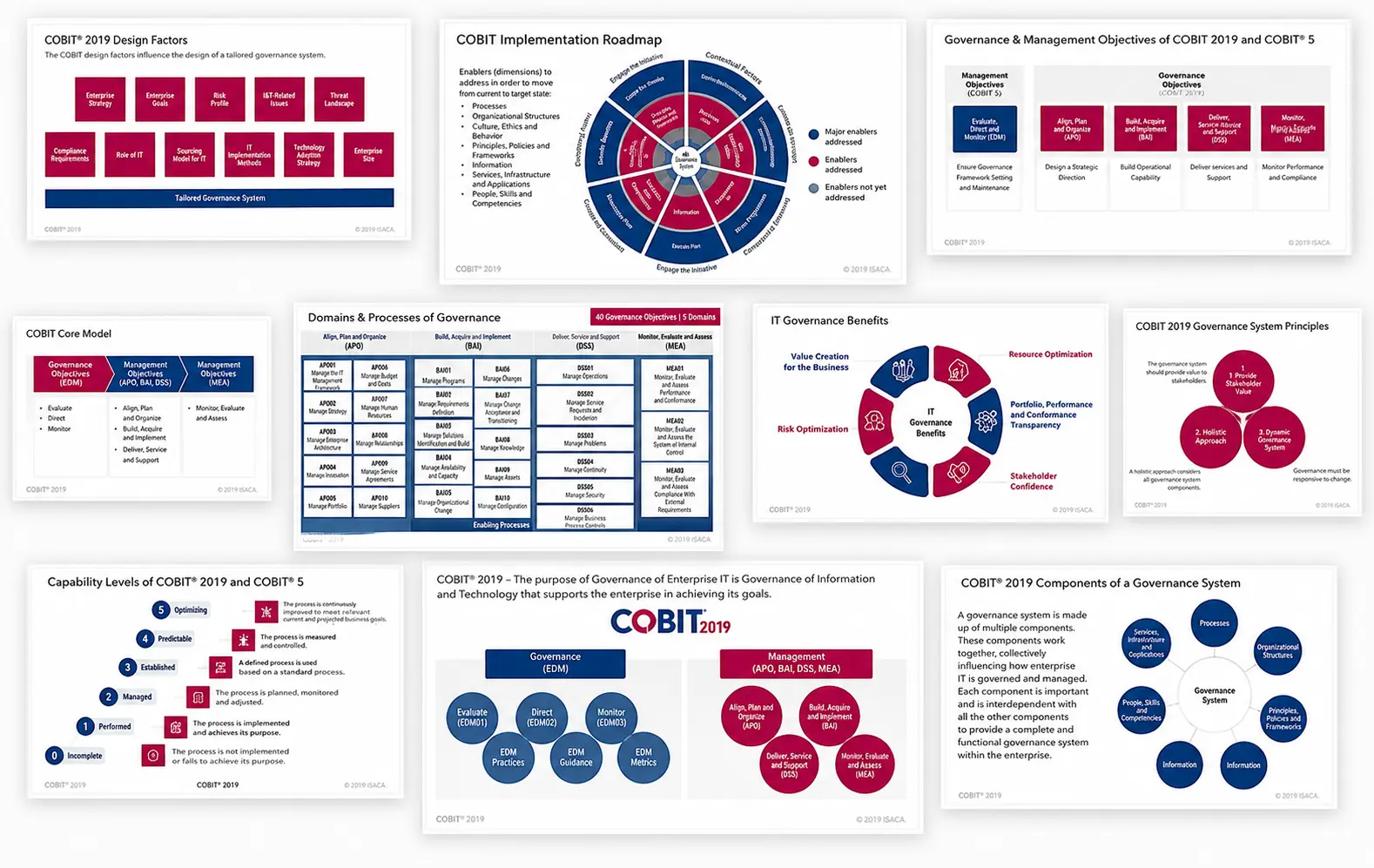
The APO (Align, Plan, Organize) Toolkits in the COBIT framework provide a comprehensive structure for aligning IT strategies with organizational goals, ensuring effective planning and organization of IT resources and processes. These templates are designed to help businesses establish a clear governance framework, optimize resource allocation, and maintain alignment between IT and business objectives.
 Part 1. Executive Alignment & APO Implementation Governance
📌Objective: To establish executive alignment and governance for the APO implementation by defining sponsorship, stakeholder alignment, steering committee structures, decision mechanisms, risks, assumptions, and implementation oversight.  APO Engagement Charter.docx APO Executive Sponsorship Agreement.docx APO Stakeholder Alignment Brief.docx APO Implementation Governance Protocol.docx APO Steering Committee Terms of Reference.docx APO Engagement Charter.docx APO Executive Sponsorship Agreement.docx APO Stakeholder Alignment Brief.docx APO Implementation Governance Protocol.docx APO Steering Committee Terms of Reference.docx APO Stakeholder Register.xlsx APO Executive Decision Log.xlsx APO Initial Risk Register.xlsx APO Implementation Assumption Log.xlsx APO Stakeholder Register.xlsx APO Executive Decision Log.xlsx APO Initial Risk Register.xlsx APO Implementation Assumption Log.xlsx APO Executive Kickoff Presentation.pptx APO Implementation Roadmap Overview.pptx APO Business Alignment Briefing.pptx
Part 2. Enterprise Context & Current-State Assessment APO Executive Kickoff Presentation.pptx APO Implementation Roadmap Overview.pptx APO Business Alignment Briefing.pptx
Part 2. Enterprise Context & Current-State Assessment
📌Objective: To assess enterprise context and current-state APO capability by reviewing strategy alignment, IT governance baseline, management practices, maturity levels, gaps, and enterprise context mapping. APO Enterprise Context Assessment Report.docx APO Current-State Capability Review.docx APO Organizational Strategy Alignment Review.docx APO IT Governance Baseline Assessment.docx APO Management Practices Assessment Guide.docx APO Current-State Assessment Questionnaire.xlsx APO Capability Baseline Matrix.xlsx APO Process Maturity Scoring Matrix.xlsx APO Enterprise Context Mapping.xlsx APO Current-State Gap Analysis.xlsx APO Current-State Diagnostic Presentation.pptx APO Enterprise Context Findings.pptx APO Capability Baseline Briefing.pptx
Part 3. APO Scope Definition & Deployment Planning
📌Objective: To define APO implementation scope and deployment planning by establishing workstreams, milestones, resources, dependencies, deployment waves, change impacts, and implementation timelines. APO Implementation Scope Document.docx APO Deployment Strategy.docx APO Workstream Definition.docx APO Implementation Planning Guide.docx APO Change Impact Assessment.docx APO Implementation Master Plan.xlsx APO Workstream Planning Tracker.xlsx APO Milestone Tracker.xlsx APO Resource Planning Matrix.xlsx APO Dependency Register.xlsx APO Deployment Wave Planning.xlsx APO Scope Confirmation Presentation.pptx APO Deployment Planning Workshop.pptx APO Implementation Timeline Presentation.pptx
Part 4. APO Framework Customization & Operating Model
📌Objective: To customize the APO framework and operating model by defining roles, responsibilities, decision rights, process ownership, policy alignment, framework tailoring, and cross-process alignment structures. APO Customization Design Document.docx APO Operating Model Design.docx APO Role Definition Guide.docx APO Decision Rights Framework.docx APO Process Ownership Model.docx APO Policy Alignment Document.docx APO Role to Responsibility Matrix.xlsx APO Decision Rights Matrix.xlsx APO Process Alignment Matrix.xlsx APO Policy Mapping Matrix.xlsx APO Framework Customization Tracker.xlsx APO Customized Framework Design Presentation.pptx APO Operating Model Alignment Presentation.pptx APO Process Ownership Workshop.pptx
Part 5. APO01 Management Framework Implementation
📌Objective: To implement APO01 by establishing the governance and management framework, process catalogue, policy register, compliance mechanisms, management practice assessments, and framework review activities. APO01 Management Framework Implementation Guide.docx APO01 Governance and Management Framework Design.docx APO01 Process Management Procedure.docx APO01 Policy Management Procedure.docx APO01 Management Framework Review Report.docx APO01 Governance Component Inventory.xlsx APO01 Process Catalogue.xlsx APO01 Policy Register.xlsx APO01 Framework Compliance Matrix.xlsx APO01 Management Practice Assessment.xlsx APO01 Management Framework Training.pptx APO01 Framework Design Workshop.pptx APO01 Implementation Status Presentation.pptx
Part 6. APO02 Strategy Management Implementation
📌Objective: To implement APO02 by defining IT strategy, strategic alignment, planning procedures, initiative portfolios, performance scorecards, strategy gap analysis, and periodic strategy review mechanisms. APO02 Strategy Management Implementation Guide.docx APO02 IT Strategy Document.docx APO02 Strategic Alignment Report.docx APO02 Strategic Planning Procedure.docx APO02 Strategy Review Report.docx APO02 Strategic Objective Mapping.xlsx APO02 Business-IT Alignment Matrix.xlsx APO02 Strategic Initiative Portfolio.xlsx APO02 Strategy Performance Scorecard.xlsx APO02 Strategy Gap Analysis.xlsx APO02 Strategy Workshop.pptx APO02 IT Strategy Presentation.pptx APO02 Strategic Alignment Briefing.pptx
Part 7. APO03 Enterprise Architecture Implementation
📌Objective: To implement APO03 by defining enterprise architecture principles, governance procedures, target architecture, architecture inventories, standards, roadmaps, decisions, and review reporting. APO03 Enterprise Architecture Implementation Guide.docx APO03 Enterprise Architecture Principles.docx APO03 Architecture Governance Procedure.docx APO03 Target Architecture Definition.docx APO03 Architecture Review Report.docx APO03 Architecture Inventory.xlsx APO03 Application Portfolio Register.xlsx APO03 Technology Standards Matrix.xlsx APO03 Architecture Roadmap Tracker.xlsx APO03 Architecture Decision Log.xlsx APO03 Enterprise Architecture Workshop.pptx APO03 Target Architecture Presentation.pptx APO03 Architecture Roadmap Briefing.pptx
Part 8. APO04 Innovation Management Implementation
📌Objective: To implement APO04 by establishing innovation governance, opportunity assessment, proof-of-concept evaluation, innovation portfolio management, emerging technology monitoring, and executive innovation review practices. APO04 Innovation Management Implementation Guide.docx APO04 Innovation Governance Procedure.docx APO04 Innovation Opportunity Assessment.docx APO04 Proof of Concept Evaluation Report.docx APO04 Innovation Portfolio Review.docx APO04 Innovation Opportunity Register.xlsx APO04 Innovation Evaluation Matrix.xlsx APO04 Proof-of-Concept Tracker.xlsx APO04 Innovation Portfolio Dashboard.xlsx APO04 Emerging Technology Watchlist.xlsx APO04 Innovation Workshop.pptx APO04 Innovation Portfolio Presentation.pptx APO04 Emerging Technology Briefing.pptx
Part 9. APO05 Portfolio Management Implementation
📌Objective: To implement APO05 by defining portfolio governance, investment business case standards, prioritization methods, portfolio value tracking, portfolio risk management, and performance review dashboards. APO05 Portfolio Management Implementation Guide.docx APO05 Portfolio Governance Procedure.docx APO05 Investment Business Case Standard.docx APO05 Portfolio Prioritization Guide.docx APO05 Portfolio Review Report.docx APO05 Initiative Portfolio Register.xlsx APO05 Investment Prioritization Matrix.xlsx APO05 Portfolio Value Tracker.xlsx APO05 Portfolio Risk Register.xlsx APO05 Portfolio Performance Dashboard.xlsx APO05 Portfolio Governance Workshop.pptx APO05 Portfolio Review Presentation.pptx APO05 Investment Prioritization Briefing.pptx
Part 10. APO06 Budget and Cost Management Implementation
📌Objective: To implement APO06 by establishing IT budgeting procedures, cost allocation models, financial controls, expense tracking, variance analysis, budget performance reporting, and financial dashboards. APO06 Budget and Cost Management Implementation Guide.docx APO06 IT Budgeting Procedure.docx APO06 Cost Allocation Model Design.docx APO06 Financial Control Procedure.docx APO06 Budget Performance Report.docx APO06 IT Budget Plan.xlsx APO06 Cost Allocation Model.xlsx APO06 Expense Tracking Workbook.xlsx APO06 Budget Variance Analysis.xlsx APO06 Financial Performance Dashboard.xlsx APO06 Budget Planning Workshop.pptx APO06 Cost Management Presentation.pptx APO06 Budget Review Briefing.pptx
Part 11. APO07 Human Resources Management Implementation
📌Objective: To implement APO07 by defining workforce planning, competency frameworks, role descriptions, skills inventories, training needs analysis, resource gaps, and capability development practices. APO07 Human Resources Management Implementation Guide.docx APO07 Workforce Planning Guide.docx APO07 Competency Framework.docx APO07 Role Description Catalogue.docx APO07 Workforce Capability Assessment Report.docx APO07 Workforce Capacity Plan.xlsx APO07 Skills Inventory.xlsx APO07 Competency Assessment Matrix.xlsx APO07 Training Needs Analysis.xlsx APO07 Resource Gap Tracker.xlsx APO07 Workforce Planning Workshop.pptx APO07 Capability Development Presentation.pptx APO07 Competency Framework Training.pptx
Part 12. APO08 Relationship Management Implementation
📌Objective: To implement APO08 by establishing business relationship management procedures, stakeholder engagement models, service expectation agreements, relationship health scorecards, demand registers, and review reporting. APO08 Relationship Management Implementation Guide.docx APO08 Business Relationship Management Procedure.docx APO08 Stakeholder Engagement Model.docx APO08 Service Expectation Agreement.docx APO08 Relationship Review Report.docx APO08 Business Stakeholder Register.xlsx APO08 Relationship Health Scorecard.xlsx APO08 Stakeholder Engagement Tracker.xlsx APO08 Business Demand Register.xlsx APO08 Relationship Issue Log.xlsx APO08 Relationship Management Workshop.pptx APO08 Business Engagement Presentation.pptx APO08 Stakeholder Review Briefing.pptx
Part 13. APO09 Service Agreements Management Implementation
📌Objective: To implement APO09 by defining service level management procedures, service catalogue design, SLA standards, service performance scorecards, SLA compliance tracking, and service review actions. APO09 Service Agreements Management Implementation Guide.docx APO09 Service Level Management Procedure.docx APO09 Service Catalogue Design.docx APO09 Service Level Agreement Standard.docx APO09 Service Review Report.docx APO09 Service Catalogue Register.xlsx APO09 Service Level Agreement Tracker.xlsx APO09 Service Performance Scorecard.xlsx APO09 Service Review Action Log.xlsx APO09 SLA Compliance Matrix.xlsx APO09 Service Catalogue Workshop.pptx APO09 Service Agreement Presentation.pptx APO09 Service Performance Review.pptx
Part 14. APO10 Supplier Management Implementation
📌Objective: To implement APO10 by establishing supplier governance, supplier evaluation standards, contract management procedures, supplier risk assessments, performance scorecards, and issue/action tracking. APO10 Supplier Management Implementation Guide.docx APO10 Supplier Governance Procedure.docx APO10 Supplier Evaluation Standard.docx APO10 Contract Management Procedure.docx APO10 Supplier Performance Review Report.docx APO10 Supplier Register.xlsx APO10 Supplier Risk Assessment Matrix.xlsx APO10 Contract Register.xlsx APO10 Supplier Performance Scorecard.xlsx APO10 Supplier Issue and Action Tracker.xlsx APO10 Supplier Governance Workshop.pptx APO10 Supplier Performance Presentation.pptx APO10 Contract Management Briefing.pptx
Part 15. APO11 Quality Management Implementation
📌Objective: To implement APO11 by establishing quality management system design, quality assurance procedures, review reports, metrics, non-conformance management, corrective actions, and continuous quality improvement. APO11 Quality Management Implementation Guide.docx APO11 Quality Management System Design.docx APO11 Quality Assurance Procedure.docx APO11 Quality Review Report.docx APO11 Continuous Quality Improvement Plan.docx APO11 Quality Metrics Register.xlsx APO11 Quality Review Checklist.xlsx APO11 Non-conformance Register.xlsx APO11 Corrective Action Tracker.xlsx APO11 Quality Performance Dashboard.xlsx APO11 Quality Management Workshop.pptx APO11 Quality Review Presentation.pptx APO11 Quality Improvement Briefing.pptx
Part 16. APO12 Risk Management Implementation
📌Objective: To implement APO12 by defining IT risk management frameworks, assessment methodology, treatment planning, risk registers, KRI dashboards, heatmaps, and management risk review reporting. APO12 Risk Management Implementation Guide.docx APO12 IT Risk Management Framework.docx APO12 Risk Assessment Methodology.docx APO12 Risk Treatment Plan.docx APO12 Risk Review Report.docx APO12 Risk Register.xlsx APO12 Risk Assessment Matrix.xlsx APO12 Risk Treatment Tracker.xlsx APO12 Key Risk Indicator Dashboard.xlsx APO12 Risk Heatmap.xlsx APO12 Risk Management Workshop.pptx APO12 Risk Profile Presentation.pptx APO12 Risk Review Briefing.pptx
Part 17. APO13 Security Management Implementation
📌Objective: To implement APO13 by designing information security management structures, policy frameworks, security governance procedures, control registers, risk assessments, compliance tracking, metrics, and improvement roadmaps. APO13 Security Management Implementation Guide.docx APO13 Information Security Management System Design.docx APO13 Security Policy Framework.docx APO13 Security Governance Procedure.docx APO13 Security Management Review Report.docx APO13 Security Control Register.xlsx APO13 Security Risk Assessment Matrix.xlsx APO13 Security Compliance Tracker.xlsx APO13 Security Metrics Dashboard.xlsx APO13 Security Improvement Roadmap.xlsx APO13 Security Management Workshop.pptx APO13 Security Governance Presentation.pptx APO13 Security Management Review.pptx
Part 18. APO Integration & Cross Domain Alignment
📌Objective: To integrate APO processes across domains by defining cross-domain operating models, process interfaces, cross-process governance, dependency matrices, integrated controls, issue tracking, and integration roadmaps. APO Cross-Domain Integration Plan.docx APO Integrated Operating Model.docx APO Process Interface Design.docx APO Cross-Process Governance Procedure.docx APO Integration Review Report.docx APO Cross-Process Dependency Matrix.xlsx APO Integrated Controls Matrix.xlsx APO Process Interface Register.xlsx APO Cross-Domain Issue Tracker.xlsx APO Integration Roadmap Tracker.xlsx APO Cross-Domain Alignment Workshop.pptx APO Integrated Operating Model Presentation.pptx APO Integration Review Briefing.pptx
Part 19. Change Management & Adoption
📌Objective: To support APO change management and adoption by defining change strategy, stakeholder engagement, impact reporting, leadership communication, readiness surveys, adoption risks, and communication campaigns. APO Change Management Strategy.docx APO Stakeholder Engagement Plan.docx APO Change Impact Report.docx APO Leadership Communication Pack.docx APO Change Impact Register.xlsx APO Stakeholder Influence Matrix.xlsx APO Adoption Risk Tracker.xlsx APO Change Readiness Pulse Survey.xlsx APO Communication Calendar.xlsx APO Change Leadership Briefing.pptx APO Adoption Roadshow Presentation.pptx APO Communication Campaign.pptx
Part 20. Pilot Implementation & Validation
📌Objective: To validate APO implementation through pilot planning, success criteria, pilot governance, issue tracking, feedback collection, success metrics, evaluation reporting, and decision gate review. APO Pilot Implementation Plan.docx APO Pilot Success Criteria.docx APO Pilot Governance Protocol.docx APO Pilot Evaluation Report.docx APO Pilot Scope Tracker.xlsx APO Pilot Issue Log.xlsx APO Pilot Feedback Tracker.xlsx APO Pilot Success Metrics Tracker.xlsx APO Pilot Kickoff.pptx APO Pilot Review Presentation.pptx APO Pilot Decision Gate Presentation.pptx |
|||||||||||||||||
|
|
|||||||||||||||||
| Price: $194.00 | |||||||||||||||||
|
|
|||||||||||||||||


 English
The IT Toolkit has truly revolutionized our IT operations. It's the foundation of our SOPs, helps generate run books, reduces training costs, and boosts user satisfaction.
After implementing the IT Toolkit, we now have a well-organized IT plan that's professional and easy for everyone to access and use.
Our clients have responded positively. Even those who had information, found ours better organized, making us more efficient and improving our IT management.
The toolkit offers a framework for best practices, ensuring that as practices evolve, our documentation system adapts seamlessly.
The IT Toolkit brings structure to documentation management, reducing the workload on engineers so they can focus more on clients. It's a game changer.
The IT Toolkit prevents duplicate entries and has replaced two other tools, making it much more effective and faster. Our engineers love it!
The IT Toolkit is incredibly easy to use with no ramp-up time. It's a straightforward process that gives clients control while simplifying their workflow.
The IT Toolkit has given me a better understanding of IT management efficiency and provides an easy, friendly way to improve our processes.
The toolkit has helped me organize my thoughts and training strategies with our IT team, making everything more streamlined.
Excellent IT Toolkit! It's essential for all CIOs and technology managers looking to enhance their operations.
A very useful toolkit, one of the best I've used. I wish every IT manager could benefit from it.
These toolkits have boosted my confidence and empowered me to grow as an IT Manager.