
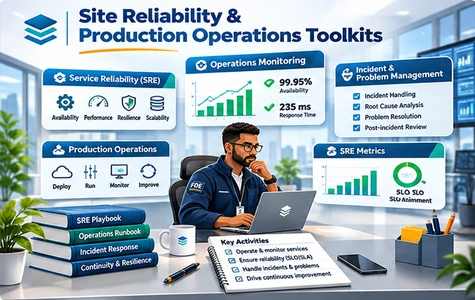
Reliable production services require measurable objectives, actionable telemetry, prepared incident response and repeatable recovery practices. The Site Reliability & Production Operations Toolkits offer practical working resources for Forward Deployed Engineers, site reliability engineers and operations leads managing services in customer and enterprise environments.
The supplied Index 17 identifies 46 files organized into 8 parts: SLI/SLO selection and error budgets; monitoring, observability signals and alert engineering; incident restoration and postmortems; backup and disaster recovery verification; production capacity and saturation; on-call duty and escalation; operational toil reduction; and controlled service retirement and customer exit.
The indexed materials include 17 Word documents, 20 Excel workbooks, 4 CSV datasets, 2 Python scripts, 2 YAML examples and 1 JSONL fixture. Use the standards, runbooks, exercises, registers and lab assets to document service expectations, review operational evidence, rehearse recovery, manage capacity and support sustainable reliability improvement. Adapt all targets, runbooks, thresholds and controls to actual service and customer obligations.
- Define measurable reliability targets with service SLI/SLO standards, selection worksheets, threshold exercises and an error budget calculator.
- Improve observability and actionable alerting using signal design guidance, telemetry examples, alert routing procedures, threshold experiments and alert quality reviews.
- Respond to incidents and verify recovery with major incident tabletop exercises, communication templates, blameless postmortems, DR runbooks, RTO/RPO tools and backup recovery evidence.
- Plan production capacity and accountable on-call coverage using saturation models, growth forecasts, duty handbooks, escalation simulations and shift handoff checklists.
- Reduce recurring operational toil and manage service exit with automation opportunity registers, improvement labs, decommissioning procedures, ownership transfers and post-exit verification.
Below is the complete document inventory from supplied Index 17: 46 files organized across 8 parts. File types include DOC, XLS, CSV, PY, YAML and JSONL.
| Type | Files List |
|---|---|
| Service_SLI_SLO_Definition_Standard.doc | |
| SLO_Threshold_Case_Exercise.doc | |
| Service_SLI_Selection_Workbook.xls | |
| Error_Budget_Calculator.xls | |
| Service_Telemetry_Test_Dataset.csv | |
| Service_Observability_Design_Guide.doc | |
| Alert_Routing_Escalation_Procedure.doc | |
| Alert_Threshold_Experiment.xls | |
| Alert_Quality_Review_Checklist.xls | |
| Observability_Configuration_Simulator.py | |
| Telemetry_Instrumentation_Example.yaml | |
| Telemetry_Log_Trace_Fixtures.jsonl | |
| Service_Incident_Response_Procedure.doc | |
| Major_Service_Incident_Tabletop.doc | |
| Blameless_Incident_Postmortem.doc | |
| Incident_Communication_Templates.doc | |
| Incident_Timeline_Reconstruction.xls | |
| Corrective_Action_Verification.xls | |
| Service_Failure_Log_Dataset.csv | |
| Service_Restore_and_DR_Runbook.doc | |
| DR_Failover_Tabletop.doc | |
| Disaster_Recovery_RTO_RPO_Calculator.xls | |
| Backup_Recovery_Test_Register.xls | |
| Recovery_Verification_Checklist.xls | |
| Service_Recovery_Simulation.yaml | |
| Capacity_Expansion_Tradeoff_Casebook.doc | |
| Operational_Capacity_Forecast.xls | |
| Burst_Demand_And_Growth_Forecast.xls | |
| Resource_Saturation_Alert_Thresholds.xls | |
| Service_Capacity_Saturation_Test_Dataset.csv | |
| On_Call_Operations_Handbook.doc | |
| On_Call_Escalation_Simulation.doc | |
| On_Call_Readiness_Review.xls | |
| On_Call_Handoff_and_Continuity_Checklist.xls | |
| On_Call_Shift_Exercise_Schedule.xls | |
| Recurring_Operations_Defect_Elimination_Casebook.doc | |
| Operational_Toil_Quantification_Model.xls | |
| Operations_Automation_Opportunity_Register.xls | |
| Reliability_Automation_Design_Review.xls | |
| Toil_Reduction_Lab.py | |
| Toil_Automation_Before_After_Test_Data.csv | |
| Operational_Service_Decommissioning_and_Customer_Exit_Procedure.doc | |
| Operational_Record_Archive_and_Ownership_Transfer_Form.doc | |
| Service_Exit_Recovery_and_Restoration_Tabletop.doc | |
| Service_Dependency_and_Decommission_Readiness_Checklist.xls | |
| Service_Cut_Off_and_Post_Exit_Verification_Register.xls | |
Price: $47.00

Secure payment via PayPal. Instant digital delivery after successful payment.

| Date File Updated | 10/04/2025 |
|---|---|
| File Format | doc, xls, csv, py, yaml, jsonl |
| No. of files | 46 Files, 8 Folders |
| File download size | 3.02 MB (.rar) |
| Language | English |
This document has been certified by a professional
100% customizable. You can edit our templates as needed.
Instant download after completing your order.
We recommend downloading this file onto your computer.
Your payment information is processed securely.
After payment, if you require an invoice, please email us.
Support contact: supports@it-toolkits.org
Engineer reliable services and operational readiness
Practical SLI/SLO tools, observability and alert reviews, incident response runbooks, DR verification, capacity planning, on-call handoffs, toil reduction and service exit records.
1. Who is this Site Reliability & Production Operations Toolkit designed for?
These resources are intended for Forward Deployed Engineers, site reliability engineers (SREs), platform teams, production operations leads, service owners, incident commanders, on-call engineers and technical delivery managers who operate or support customer-facing services.
2. What is included in the Site Reliability & Production Operations Toolkit?
The supplied Index 17 lists 46 files in 8 parts covering SLI/SLO and error budgets, observability, incident response, disaster recovery, capacity, on-call operations, toil reduction and service retirement.
3. How many files and what formats are provided?
There are 46 indexed files: 17 Word (.doc), 20 Excel (.xls), 4 CSV (.csv), 2 Python (.py), 2 YAML (.yaml) and 1 JSON Lines (.jsonl). The full inventory appears in the Toolkit Documents table.
4. Does the toolkit help define service level indicators and objectives?
Yes. Part 1 contains a Service SLI SLO Definition Standard, SLO threshold exercise, SLI selection workbook and an error budget calculator. Service owners should validate definitions against actual user journeys and measured telemetry.
5. How can teams use error budgets in production operations?
The Error Budget Calculator in Part 1 supports discussion of the allowable reliability gap associated with an agreed SLO. Any release or operational decisions should use the organization’s approved policies and actual service measurements.
6. What observability and alert engineering resources are included?
Part 2 lists an Observability Design Guide, alert routing and escalation procedure, alert threshold experiment, alert quality checklist, Python configuration simulator, YAML instrumentation example and JSONL telemetry fixtures.
7. Are there practical telemetry examples and simulation assets?
Yes. The index includes Service Telemetry Test Dataset.csv, Observability Configuration Simulator.py, Telemetry Instrumentation Example.yaml and Telemetry Log Trace Fixtures.jsonl to support structured practice and analysis.
8. Does the toolkit cover major incident response and communication?
Part 3 includes a Service Incident Response Procedure, Major Service Incident Tabletop and incident communication templates, alongside incident timeline reconstruction and corrective action verification tools.
9. Can it support blameless postmortems and root-cause investigation?
Yes. A Blameless Incident Postmortem document and incident timeline workbook can help teams organize evidence, distinguish contributing conditions and follow up corrective actions after service restoration.
10. What disaster recovery and backup verification materials are available?
Part 4 includes a Service Restore and DR Runbook, DR failover tabletop, RTO/RPO calculator, backup recovery test register, recovery verification checklist and a YAML service recovery simulation.
11. Are RTO and RPO calculations included?
Yes. The Disaster Recovery RTO RPO Calculator.xls is listed in Part 4. Recovery targets must be agreed with service stakeholders and validated through exercises and technical capabilities.
12. How does the toolkit address production capacity and saturation?
Part 5 provides an operational capacity forecast, burst demand and growth forecast, resource saturation thresholds and a synthetic capacity dataset. These can support proactive review of observed workload trends and infrastructure limits.
13. Are on-call rotations, escalation and handovers included?
Yes. Part 6 contains an On-Call Operations Handbook, escalation simulation, on-call readiness review, handoff and continuity checklist, and on-call shift exercise schedule.
14. Can these materials help reduce operational toil?
Part 7 includes an Operational Toil Quantification Model, automation opportunity register, reliability automation design review, toil reduction Python lab and before/after test data. Improvement prioritization should consider risk and maintainability.
15. Does the toolkit cover decommissioning and customer service exit?
Yes. Part 8 contains a service decommissioning and customer exit procedure, record archive and ownership transfer form, service exit tabletop, dependency readiness checklist and post-exit verification register.
16. Can I customize the materials for different production environments?
The indexed documents, workbooks, configuration examples and scripts can be adapted to cloud, hybrid, enterprise and customer operations. Review service dependencies, data handling, authorization, recovery risks and production change controls before practical use.
17. Can I review the toolkit document list before buying?
Yes. The Toolkit Documents section displays the exact filenames and Part ordering from Index 17. The Download Toolkit Index and Payment Guide controls are retained from the source webpage template.
18. What is the price and how can I get support?
The displayed toolkit price is $47.00 USD. The PayPal forms are unchanged from the supplied website template. For purchase or access questions, contact supports@it-toolkits.org.
Cloud, Hybrid & Edge Platform Engineering Toolkits
Design and operate cloud, hybrid and edge platforms with infrastructure resilience and platform engineering practices.
DevOps, CI/CD & Infrastructure Automation Toolkits
Connect service reliability goals to automated delivery, infrastructure changes and engineering controls.
Production Deployment, Release & Cutover Toolkits
Support safe go-live decisions, release verification, rollback plans and operations handovers.
Cybersecurity, Privacy & Technical Compliance Toolkits
Align production operations and incident activities with security, privacy and control requirements.
Software Quality, Testing & Validation Toolkits
Use automated, load and recovery testing evidence to validate reliability expectations.
Technical Governance, Risk & Decision Management Toolkits
Strengthen risk-based operational decisions, escalation boundaries and evidence-based assurance.


English