
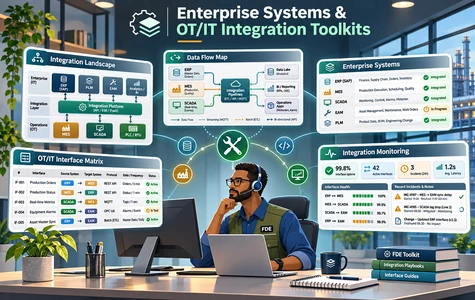
Connecting enterprise applications to operational technology requires a clear view of system interfaces, ownership, data contracts, transaction flow and operational safety. The Enterprise Systems & OT/IT Integration Toolkits bring together practical FDE reference materials for planning, developing and reviewing integrations across enterprise platforms and industrial environments.
Organized into 7 focused parts and 45 indexed files, the toolkit covers interface discovery and topology, API contracts and versioning, event-driven messaging, ERP/CRM business workflows, industrial OT/IT interoperability, end-to-end reconciliation and sector-specific patterns for healthcare and financial services. The inventory includes documents, spreadsheets, editable diagrams, Python exercises, sample data and interface specifications.
FDE engineers, enterprise architects, integration leads and OT/IT stakeholders can use these materials to map dependencies, assess interface changes, explore failure and recovery scenarios, review plant authorization boundaries and validate cross-system transactions. Labs and example data are intended for controlled engineering exercises and should be adapted and verified before any production deployment.
- Make enterprise integration dependencies visible using interface ownership catalogs, dependency registers, review worksheets and topology diagrams.
- Strengthen API contract and schema decisions with transformation matrices, version comparisons, compatibility checks, OpenAPI specifications and Python lab exercises.
- Assess event-driven reliability through messaging checklists, dead-letter queue decisions, retry/idempotency simulations and representative event fixtures.
- Coordinate ERP, CRM and industrial OT/IT interfaces with business transaction maps, MQTT/OPC UA boundary exercises, PLC/SCADA/MES diagrams and plant authorization controls.
- Verify end-to-end integration outcomes using reconciliation models, fault-injection exercises, sample datasets and regulated-industry interoperability casebooks.
Below is the complete file inventory from the supplied Index 08: 45 resources organized into 7 parts. Formats include DOC, XLS, Draw.io, Python, JSON, YAML, JSONL and CSV.
| Type | Files List |
|---|---|
| Enterprise_Integration_Discovery_Guide.doc | |
| Interface_Ownership_and_Dependency_Catalog.xls | |
| Integration_Interface_Design_Review.xls | |
| Enterprise_Interface_Topology.drawio | |
| Enterprise_System_Simulator_Data.json | |
| API_Contract_Design_Procedure.doc | |
| Request_Response_Transformation_Matrix.xls | |
| Backward_Compatibility_Checklist.xls | |
| API_Version_Comparison.xls | |
| API_Schema_Evolution_Lab.py | |
| Enterprise_Interface_OpenAPI.yaml | |
| API_Contract_Exercise_Fixtures.json | |
| Dead_Letter_Queue_Decision_Workbook.xls | |
| Messaging_Reliability_Review_Checklist.xls | |
| Event_Integration_Architecture.drawio | |
| Message_Retry_Idempotency_Simulator.py | |
| Event_Bus_Message_Contract.json | |
| Out_of_Order_Message_Fixtures.jsonl | |
| ERP_CRM_Integration_Playbook.doc | |
| ERP_Integration_Exception_Cases.doc | |
| Procure_to_Pay_Data_Contract.xls | |
| Enterprise_Transaction_Mapping.xls | |
| Integration_Business_Validation_Checklist.xls | |
| Order_to_Cash_Integration_Map.drawio | |
| CRM_ERP_Workflow_Automation_Lab.py | |
| Business_Transaction_Sample_Data.csv | |
| Industrial_OT_MQTT_OPCUA_Boundary_Exercise.doc | |
| OT_IT_Interface_Safety_Boundary_Standard.doc | |
| OT_Integration_Hazard_Scenario_Casebook.doc | |
| Industrial_OT_Protocol_Interface_Catalog.xls | |
| Industrial_Protocol_Data_Mapping_Matrix.xls | |
| OT_Change_Window_and_Plant_Authorization_Checklist.xls | |
| PLC_SCADA_MES_Interface_Topology.drawio | |
| OT_Data_Buffer_StoreForward_Simulator.py | |
| Cross_System_Reconciliation_Procedure.doc | |
| Interface_Recovery_Scenario_Exercise.doc | |
| Integration_Transaction_Reconciliation_Model.xls | |
| Reconciliation_Result_Review.xls | |
| Integration_Fault_Injection_Test_Lab.py | |
| Source_Target_Transaction_Dataset.csv | |
| Healthcare_FHIR_Interoperability_Workflow_Casebook.doc | |
| Financial_Services_Message_Integration_Casebook.doc | |
| Regulated_Industry_Interface_Profile_and_Constraints.xls | |
| Regulated_Industry_Interface_Conformance_Checklist.xls | |
| Regulated_Interface_Test_Message_Fixtures.json | |
Price: $47.00

Secure payment via PayPal. Instant digital delivery after successful payment.

| Date File Updated | 10/04/2025 |
|---|---|
| File Format | doc, xls, drawio, py, json, yaml, jsonl, csv |
| No. of files | 45 Files, 7 Folders |
| File download size | 3.02 MB (.rar) |
| Language | English |
This document has been certified by a professional
100% customizable. You can edit our templates as needed.
Instant download after completing your order.
We recommend downloading this file onto your computer.
Your payment information is processed securely.
After payment, if you require an invoice, please email us.
Support contact: supports@it-toolkits.org
Design and verify enterprise and OT/IT integrations with greater clarity
Bring API contracts, event reliability, ERP/CRM workflows, industrial interface safeguards and transaction reconciliation into a structured engineering workflow.
1. Who is the Enterprise Systems & OT/IT Integration Toolkit designed for?
It is intended for Forward Deployed Engineers, integration architects, API developers, ERP/CRM specialists, industrial OT/IT engineers, solution consultants and technical delivery leads working across business applications, data exchange and operational systems. Plant owners and control engineers should review any OT-facing work.
2. What files are included in this toolkit?
The supplied Index 08 lists 45 resources organized into 7 parts, covering enterprise interfaces, contract engineering, messaging reliability, ERP/CRM integration, OT/IT boundaries, transaction reconciliation and regulated-industry patterns.
3. What file formats and quantities are included?
The index includes 11 DOC files, 17 XLS workbooks, 4 Draw.io diagrams, 5 Python scripts, 4 JSON files, 1 YAML specification, 1 JSONL fixture and 2 CSV datasets. These materials span documentation, analysis, models, code exercises and representative test data.
4. How does the toolkit help identify enterprise integration dependencies?
Part 1 includes an Enterprise Integration Discovery Guide, an interface ownership and dependency catalog, an integration design review and an enterprise interface topology diagram. These help document which systems exchange information and who is responsible for each interface.
5. Does the toolkit cover API contracts and schema versioning?
Yes. Part 2 includes API contract design guidance, request/response transformation mapping, backward-compatibility checks, version comparisons, an OpenAPI YAML specification and a schema evolution Python lab.
6. Are event-driven messaging patterns and reliability included?
Part 3 includes a dead-letter queue decision workbook, messaging reliability review checklist, event architecture diagram, retry/idempotency simulator and sample message/ordering fixtures. These are resources for analyzing failure handling rather than a production messaging service.
7. How can teams use the ERP and CRM integration resources?
Part 4 provides an ERP/CRM integration playbook, integration exception cases, procure-to-pay contract, transaction mapping workbook, business validation checklist, order-to-cash diagram, Python workflow lab and sample transaction data.
8. Does the toolkit address MQTT, OPC UA, PLC, SCADA and MES interfaces?
Yes. Part 5 names an Industrial OT MQTT/OPC UA Boundary Exercise, industrial protocol catalogs and mappings, a PLC/SCADA/MES topology diagram, and a store-and-forward data buffer simulator. These support interface analysis and controlled practice, not authorization for direct plant connections.
9. What safeguards apply when working across the OT/IT boundary?
Part 5 includes an OT/IT Interface Safety Boundary Standard, OT hazard scenarios and a plant change-window authorization checklist. Any use in industrial operations must follow site-specific safety controls, change approvals, access restrictions and operating procedures.
10. Can the toolkit support end-to-end transaction reconciliation?
Part 6 provides a cross-system reconciliation procedure, reconciliation workbooks, interface recovery scenarios, a fault-injection test lab and a source/target transaction dataset to help structure verification and exception analysis.
11. What testing materials are provided for integration failures?
Representative exercises include message retry/idempotency simulation, API schema evolution, store-and-forward buffering, interface recovery and integration fault injection. Teams should run scripts and sample data in isolated, authorized test environments and validate them before adapting their methods.
12. Are healthcare interoperability scenarios included?
Part 7 lists a Healthcare FHIR Interoperability Workflow Casebook, alongside a regulated-industry interface profile, conformance checklist and test-message fixtures. The casebook is not, by itself, evidence of regulatory compliance.
13. Are financial services integration scenarios included?
Yes. Part 7 includes a Financial Services Message Integration Casebook, cross-industry interface constraints, a conformance checklist and representative regulated-interface fixtures. Implementation must be tailored to applicable financial-service obligations.
14. How can engineering teams evaluate changes to an existing interface?
Teams can combine the dependency catalog, API version comparison, backward-compatibility checklist, transaction mappings, event reliability checks and reconciliation models to review potential downstream effects before approving a change.
15. Can the supplied files be adapted for our technology stack?
The index identifies editable reference formats and source-code exercises that can be reviewed and tailored. Adaptation may require compatible office software, Draw.io and Python tooling, plus review of security, licensing, protocols and customer-specific constraints. The index does not promise plug-and-play production components.
16. Is this toolkit a substitute for plant safety approval or regulatory certification?
No. The resources support planning, review and training; they do not replace plant management authorization, security assessments, formal testing, engineering sign-off or any relevant sector-specific approval or certification.
17. What is the price and how does purchasing work?
The listed price is $47.00 USD. Checkout uses the existing PayPal payment form in the website template, with purchase and delivery information described in the Payment Guide. For assistance, contact supports@it-toolkits.org.
18. How can I review the file inventory or request technical assistance?
The complete 45-file inventory is provided in the Toolkit Documents table above. For information about file access, compatible software or tailoring these resources to an enterprise or OT/IT environment, email supports@it-toolkits.org.
Solution Architecture & Technical Design Toolkits
Develop interface architectures, document dependencies and assess technical design trade-offs.
Software & Application Engineering Toolkits
Connect application design and API implementation with practical software engineering activities.
Data Engineering & Analytics Toolkits
Extend cross-system integration into data pipelines, quality checks and downstream analytics.
Cloud, Hybrid & Edge Platform Engineering Toolkits
Plan the platform environments needed for enterprise services and industrial edge connectivity.
Cybersecurity, Privacy & Technical Compliance Toolkits
Assess access boundaries, data protection and technical obligations for integrated systems.
Software Quality, Testing & Validation Toolkits
Support interface testing, integration validation and defect follow-up before release.


English